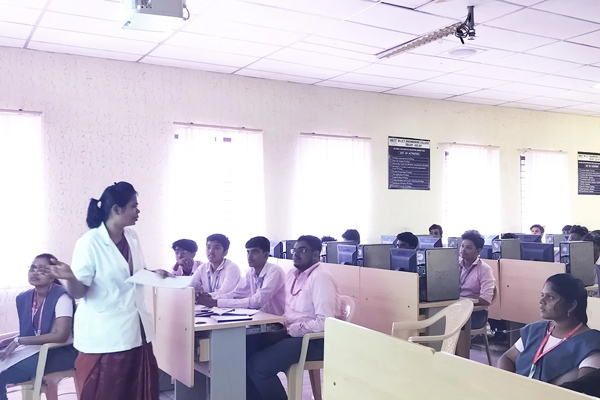
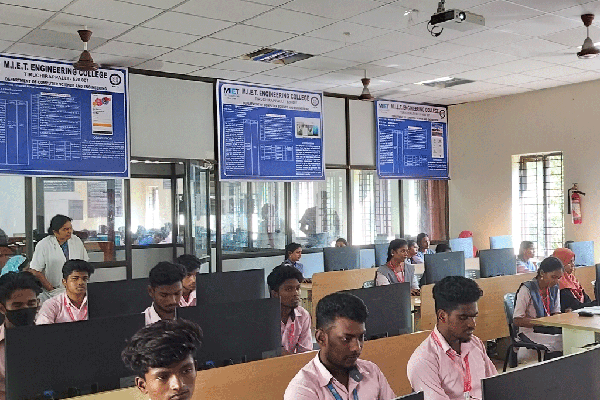
The Department of Information Technology (IT) was established in the year 2022 with the primary objective of generating human resources with professional expertise and skills in IT. The department offers an U.G. Degree programme, B.Tech Information Technology with a sanctioned intake of 120 students. A team of highly qualified faculty members and well-equipped laboratories and excellent academic environment collectively contribute the students for acquiring technical skills and inculcate the spirit of team work and to update their knowledge in recent technological developments. The curriculum update and modernization of the labs are upgraded periodically so as to keep the students well informed about the latest trends at the global level. The careers in Information Technology deals with the design, creation, management and maintenance of the varied components of the system. The students are encouraged to be a part of professional bodies like Computer Society of India, ISTE and IEEE.
Student Achievements
SI.NO
NAME OF THE STUDENT
YEAR
ORGANIZED BY INSTITUTIONS / INDUSTRY
DATE & VENUE
PRIZES WON
1
Vigneshwaram M
II
University College of Engineering, BIT Campus, Trichy
24.05.2024
Site Craft
I Prize
2
Sanjay Kishore S
II
BigLearn, Trichy
22.05.2024
Workshop
Participated
3
Vigneshwaram M
II
Mookambigai College of Engineering, Pudukkottai
26.04.2024
Byte Battle
Participated
4
Pooja C
II
M.A.M College of Engineering and Technology, Trichy
27.03.2024
Tech Quiz
Participated
5
Santhiya R
II
M.A.M College of Engineering and Technology, Trichy
27.03.2024
Tech Quiz, Connections
Participated
6
Arafath M
II
K. Ramakrishnan College of Engineering and Technology, Trichy
03.11.2023
Protech
I Prize
VISION & MISSION
Vision
To become a world class technology department through innovation, excellence, discovery and to generate graduates of globally recognized innovative computing professionals.
Mission
To equip the graduates with technological expertise and ethically responsible through dynamic curriculum.
To provide an environment for continuous learning and to develop ethical value to address societal problems.
To enrich the graduates with knowledge on latest technological development to make them industry ready.
Program Educational Objectives (PEO) & Program Specific Outcomes (PSO)
PEO
Demonstrate technical and analytical skills to meet the diverse needs of industry, academia and research.
Show leadership, teamwork and entrepreneurial abilities to solve real-world problems.
Work responsibly in multidisciplinary environments and use advanced technologies for lifelong learning and applied research.
PSO
Demonstrate strong programming skills to design and implement solutions for complex engineering problems.
Use advanced technologies to build business solutions and pursue research in applied computing.
Board of Study members
S.No.
Name of the Members
Designation
Position
1
Dr.I.Shahanaz Begum
Professor& Dean /CSE,
M.I.E.T. Engineering College, Tiruchirapalli
Professor/CSE
Department of Computer Science and Engineering, Thiagarajar College of Engineering, Madurai
University Nominee
5
Dr.S.Nickolas
Professor/CSE
Department of Computer Applications,
National Institute of Technology, Tiruchirapalli
Subject Expert
6
Dr.S.Nagarajan
Associate Professor/CSE,
Department of Computer Science and Engineering, Government College of Engineering - Srirangam, Tiruchirapalli
Subject Expert
7
Ms.A.K.Ayesha Shereen
Capgemini Technology Services Pvt. Ltd, Chennai
Industry Expert
8
Mr.M.Mohamed Abdullah
Adella Software & Services, Trichy
Alumni
All Faculty members of Information Technology Department
Minutes of Meeting
PROGRAMME OUTCOMES (PO)
PO 1 - Engineering knowledge: Apply knowledge of mathematics, natural science, computing, engineering fundamentals and an engineering specialization as specified in WK1 to WK4 respectively to develop to the solution of complex engineering problems.
PO 2 - Problem analysis: Identify, formulate, review research literature and analyze complex engineering problems reaching substantiated conclusions with consideration for sustainable development. (WK1 to WK4)
PO 3 - Design/development of solutions: Design creative solutions for complex engineering problems and design/develop systems/components/processes to meet identified needs with consideration for the public health and safety, whole-life cost, net zero carbon, culture, society and environment as required. (WK5)
PO 4 - Conduct investigations of complex problems: Conduct investigations of complex engineering problems using research-based knowledge including design of experiments, modelling, analysis & interpretation of data to provide valid conclusions. (WK8).
PO 5 - Engineering tool usage: Create, select and apply appropriate techniques, resources and modern engineering & IT tools, including prediction and modelling recognizing their limitations to solve complex engineering problems. (WK2 and WK6)
PO 6 - The Engineer and The World: Analyze and evaluate societal and environmental aspects while solving complex engineering problems for its impact on sustainability with reference to economy, health, safety, legal framework, culture and environment. (WK1, WK5, and WK7).
PO 7 - Ethics:Apply ethical principles and commit to professional ethics, human values, diversity and inclusion; adhere to national & international laws. (WK9)
PO 8 - Individual and Collaborative Team work: Function effectively as an individual, and as a member or leader in diverse/multi-disciplinary teams.
PO 9 - Communication:Communicate effectively and inclusively within the engineering community and society at large, such as being able to comprehend and write effective reports and design documentation, make effective presentations considering cultural, language, and learning differences.
PO 10 - Project Management and Finance:Apply knowledge and understanding of engineering management principles and economic decision-making and apply these to one’s own work, as a member and leader in a team, and to manage projects and in multidisciplinary environments.
PO 11 - Life-Long Learning: Recognize the need for, and have the preparation and ability for i) independent and life-long learning ii) adaptability to new and emerging technologies and iii) critical thinking in the broadest context of technological change. (WK8)
Knowledge and Attitude Profile (WK)
WK 1 - A systematic, theory-based understanding of the natural sciences applicable to the discipline and awareness of relevant social sciences.
WK 2 - Conceptually-based mathematics, numerical analysis, data analysis, statistics and formal aspects of computer and information science to support detailed analysis and modelling applicable to the discipline.
WK 3 - A systematic, theory-based formulation of engineering fundamentals required in the engineering discipline.
WK 4 - Engineering specialist knowledge that provides theoretical frameworks and bodies of knowledge for the accepted practice areas in the engineering discipline; much is at the forefront of the discipline.
WK 5 - Knowledge, including efficient resource use, environmental impacts, whole-life cost, re-use of resources, net zero carbon, and similar concepts, that supports engineering design and operations in a practice area.
WK 6 - Knowledge of engineering practice (technology) in the practice areas in the engineering discipline.
WK 7 - Knowledge of the role of engineering in society and identified issues in engineering practice in the discipline, such as the professional responsibility of an engineer to public safety and sustainable development.
WK 8 - Engagement with selected knowledge in the current research literature of the discipline, awareness of the power of critical thinking and creative approaches to evaluate emerging issues.
WK 9 - Ethics, inclusive behavior and conduct. Knowledge of professional ethics, responsibilities, and norms of engineering practice. Awareness of the need for diversity by reason of ethnicity, gender, age, physical ability etc. with mutual understanding and respect, and of inclusive attitudes.
The department initiates innovative methods to make the students actively participate in the teaching-learning process through student centric learning activities such as google class room, audio/video lecturers, peer to peer learning, role play, demonstration of model, Inquiry based learning, collaborative learning etc.,
Google Classroom
The google classroom label describes the teaching structure that has students watching pre-recorded lessons at home and completing in-class assignments, as opposed to hearing lectures in class and doing homework at home. Teachers who implement the google classroom model often film their own instructional videos, but many also use pre-made videos from online sources.
Peer to Peer Learning
Three or four like-minded students are pooled together to form a group and to help each other in academic activities to excel in University examinations. The members of each group coordinate their efforts by producing quality output of the task given to them. Every member of the group shares his/her knowledge and ideas with other members of the group. It enhances individual’s knowledge and skills and inculcates team work and leadership quality. Peer to Peer review is obtained through which students are actively involved in their own learning and establishing a connection between the learner and the learning object.
Role play
An important key element to understand the concepts. In this activity a group of students are actively involved to demonstrate a particular concept in action. This will help the students to comprehend the topics with ease. The purpose of these activities is to ensure tracking students development, revealing the learning progress, highlighting the best work and involving the students in assessment process.
Demonstration of models
The real time working models are demonstrated in the class to connect the tangible model with the theoretical concept. This helps the students to easily understand the working principles of electrical engineering components.
Inquiry-based Learning
Encouraging students to ask questions and investigate their own ideas that helps in improving their problem-solving skills
Collaborative learning
Collaboration allows students to actively participate in the learning process by talking with each other and listening to others opinions. Collaboration establishes a personal connection between students and the topic of study and it helps students think in a less personally biased way. Group projects and discussions are the topics . Teachers may employ collaboration to assess student’s abilities to work as a team, leadership skills, or presentation abilities
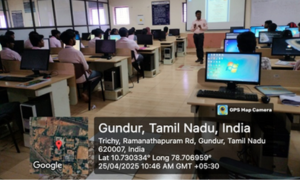
Intel Core i7, Asus Motherboard, Crucial 16GB DDR4 RAM, LEXAR 512GB SSD Hard Disk, Samsung 22″ LED Monitor, Dell USB Keyboard, Dell Optical Mouse, Sony Projector
Intel Core i7, Asus Motherboard, Crucial 16GB DDR4 RAM, LEXAR 512GB SSD Hard Disk, Samsung 22″ LED Monitor, Dell USB Keyboard, Dell Optical Mouse, Sony Projector
“AI-Infused Cyber Security - Guset Lecture” on 20.08.2026
Topic: “AI-Infused Cyber Security”
Date: 20.08.2026
Venue: “B” Block Seminar Hall
No. of participants: 98
Resource person: Mr. S.A Syed Khaja
Cyber security Instructor, Big learn,
Tiruchirappalli.
Objective of Program:
To provide students with an understanding of the role of Artificial Intelligence (AI) in modern cybersecurity.
To introduce emerging AI-based techniques for threat detection, malware analysis, intrusion detection, and cyber-attack prevention.
Topics Covered
Fundamentals and applications of Artificial Intelligence in cybersecurity, with emphasis on the role of AI and machine learning in threat detection, intrusion detection, malware and ransomware identification, phishing and social engineering detection, behavioral analysis, and anomaly detection.
Outcomes
AI in Cybersecurity: Gained knowledge about the integration of Artificial Intelligence in cybersecurity, including threat and intrusion detection.
AI-Based Security Solutions: Learned about AI applications in malware analysis, phishing detection, anomaly detection, and automated security solutions.
PO & PSO Mapping
PO1
PO2
PO3
PO4
PO5
PO6
PO7
PO8
PO9
PO10
PO11
PSO1
PSO2
2
3
2
3
3
3
–
–
–
–
–
3
2
“AI-Driven Network Security Workshop” on 20.08.2026
Topic: “AI-Driven Network Security Workshop”
Date: 20.08.2026
Venue: “C” Block Computer Lab
No. of participants: 72
Resource person: Mr. S.A Syed Khaja
Cyber security Instructor, Big learn,
Tiruchirappalli.
Objective of Program:
To understand the role of Artificial Intelligence (AI) and Machine Learning (ML) in detecting and preventing modern network security threats.
To develop awareness of AI-based threat detection, intrusion detection, anomaly identification, and automated network security solutions.
Topics Covered
The workshop on “AI-Driven Network Security” covered the fundamentals of Artificial Intelligence and Machine Learning in network security, with a focus on AI-based threat and intrusion detection techniques.
Participants gained knowledge of anomaly detection and network traffic analysis for identifying suspicious activities. The workshop also discussed the application of AI in malware and phishing detection, automated threat response, and security monitoring. Additionally, emerging cybersecurity threats and AI-driven security solutions were explored to enhance the understanding of modern approaches to protecting networks and information systems.
Outcomes
Students gained practical knowledge of applying Artificial Intelligence and Machine Learning techniques to identify, analyze, and prevent various network security threats.
Students developed awareness of AI-based intrusion detection, anomaly detection, malware and phishing detection, and automated security response, enhancing their skills in modern cybersecurity practices.
PO & PSO Mapping
PO1
PO2
PO3
PO4
PO5
PO6
PO7
PO8
PO9
PO10
PO11
PSO1
PSO2
3
2
2
2
3
3
–
–
–
–
–
3
3
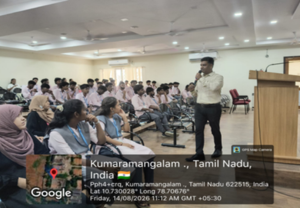
“Milestones & Opportunities to Career Growth” on 14.08.2026
Topic: “Milestones & Opportunities to Career Growth”
Date: 14.08.2026
Venue: “B” Block Seminar Hall
No. of participants: 74
Resource person: Mr.S.Senthilkumar, Mrs.S.Manochitra
SEBI SMART Trainer, Chennai
Tamil Nadu.
Objective of Program:
To teach the financial literacy and empower students to make informed financial decisions.
Awareness of the students to carry out real life financial planning,investing,protection against financial scams.
Topics Covered
Important aspects of investing, financial planning, mutual funds, investor rights, insurance awareness, and protection against financial scams.
Outcomes
Students can Learn effective financial management skills that help students build a stable, successful, and financially secure career.
Increased awareness of currently different types scam.
PO & PSO Mapping
PO1
PO2
PO3
PO4
PO5
PO6
PO7
PO8
PO9
PO10
PO11
PSO1
PSO2
3
3
3
3
3
3
–
–
–
3
3
3
3
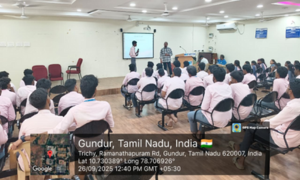
One Day Workshop on “Angular for Real - World Impact” on 26.09.2025
Topic: “Angular for Real - World Impact”
Date: 26.09.2025
Resource person: Mr.S.Alex Pandi
Senior Technical Lead,
HCL Tech, Chennai.
Objective of Program:
To understand and apply core Angular concepts such as components, modules, templates, and services to build dynamic web applications.
To develop real-world web solutions that address practical user and business needs using Angular’s modern features.
Demonstrate real-world impact by developing and presenting an Angular application that solves a genuine problem or improves user experience.
Topics Covered
Fundamentals, Building Dynamic User Interfaces, Routing and Navigation, Working with APIs and Data and Testing and Quality Assurance.
Outcomes
Students are able to demonstrate a solid understanding of Angular fundamentals, to build interactive, responsive, and data-driven web applications.
PO & PSO Mapping
PO1
PO2
PO3
PO4
PO5
PO6
PO7
PO8
PO9
PO10
PO11
PO12
PSO1
PSO2
H
M
M
M
H
M
–
–
–
–
–
-
M
H
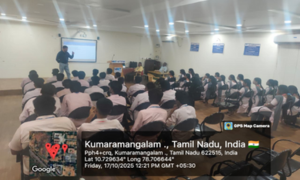
One Day Workshop on “Ethical Hacking Bootcamp” on 17.10.2025
Topic: “Ethical Hacking Bootcamp”
Date: 17.10.2025
Venue: “B” Block Seminar Hall
Target Audience: II Year IT
Resource person: Mr.Chiranjeevi Turaga
IT Trainer,
Gtec Computer Education,
Tiruchirappalli.
Objective of Program:
To Teach foundational concepts of cybersecurity and ethical hacking.
To Explain legal, ethical and professional responsibilities for security testing.
Topics Covered
Legal, Ethical, and Professional Responsibilities for Security Testing, Cyber security Standards and Best Practices, Professional Responsibilities.
Outcomes
Students can learn about the Ethical Hacking, how to place the companies, what abilities are required to place those companies, and what engineers are expected to do by companies.
PO & PSO Mapping
PO1
PO2
PO3
PO4
PO5
PO6
PO7
PO8
PO9
PO10
PO11
PO12
PSO1
PSO2
H
M
M
M
H
M
–
–
–
–
–
-
M
H
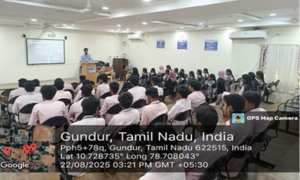
One Day Workshop on "Digital age on Cybersecurity" on 22.08.2025
Topic: “Digital age on Cybersecurity”
Date: 22.08.2025
Venue: EEE Seminar Hall
Target Audience: IV Year IT
Resource person: Mr.S.A.Syed Khaja,
Cybersecurity Trainer,
Big Learn,
Technology Training Company,
Tiruchirappalli.
Objective of Program:
To make the students to learn and understand the Concept of Cybersecurity.
It aims to enhance awareness of digital threats, promote best practices for online safety, and equip individuals and organizations with practical tools and strategies to protect their data, systems, and digital identities in an increasingly interconnected world.
Topics Covered
Fundamentals, Security and Privacy in Cybersecurity, Cyber threats and attacks.
Outcomes
The students are able to identify the Cybersecurity Challenges.
The students are able to recognize and respond to Emerging Cybers Threats.
PO & PSO Mapping
PO1
PO2
PO3
PO4
PO5
PO6
PO7
PO8
PO9
PO10
PO11
PO12
PSO1
PSO2
H
M
M
H
M
-
–
–
–
–
–
M
M
H
One Day Workshop on “AIoT: A hands-on Approach” on 25.04.2025
Topic: “AIoT: A hands-on Approach”
Date: 25.04.2025
Venue: “C”-Block Computer Lab
Target Audience: III Year IT
Resource person: Dr. C. Sankar Ram
Assistant Professor,
Anna University,
BIT Campus,
Tiruchirappalli.
Objective of Program:
To provide practical knowledge and skills in integrating Artificial Intelligence (AI) with the Internet of Things (IoT) for innovative and efficient solutions across various applications.
By focusing on hands-on learning, it empowers participants to design, develop, and deploy AI-driven IoT systems tailored to real-world challenges. Internet of Things, IoT in health care, Service under Telehealth umbrella, Benefits of Telehealth services etc.,
Topics Covered
IoT Fundamentals, Security and Privacy in AIoT, Edge Computing.
Outcomes
Students can learn about AI with Internet of Things, how to place the companies, what abilities are required to place those companies, and what engineers are expected to do by companies.
PO & PSO Mapping
PO1
PO2
PO3
PO4
PO5
PO6
PO7
PO8
PO9
PO10
PO11
PO12
PSO1
PSO2
H
M
M
M
H
M
–
–
–
–
–
M
H
H
Professional Guidance: “Navigating your path to FAANG and Beyond” on 15.11.2024
Topic: “Navigating your path to FAANG and Beyond"
Venue: ‘C’ Block Seminar Hall
Target Audience: II & III Year IT, AI&DS
Resource person: Mr. S. Amrutam Sunil
Software Development Engineer,
Amazon,
Chennai.
Objective of Program:
To devise intervention strategies for developing, engaging, rewarding and retaining talented personnel.
To apply models of career counselling that are appropriate for use in an organizational set-up.
Topics Covered
FAANG, Transitioning from College to Industry Learning & Success.
Outcomes
Students can learn about the FAANG, how to place the companies, what abilities are required to place those companies, and what engineers are expected to do by FAANG companies.
PO & PSO Mapping
PO1
PO2
PO3
PO4
PO5
PO6
PO7
PO8
PO9
PO10
PO11
PO12
PSO1
PSO2
H
M
M
M
H
M
–
–
–
–
–
–
M
H
Workshop: “Full Stack Development” on 23.10.2024
Topic: “Full Stack Development"
Venue: B’ Block Seminar Hall
Target Audience: III Year IT, AI&DS
Resource person: Ms. V. Swetha
Full Stack Developer, ,
Big Learn,,
Tiruchirappalli.
Objective of Program:
To make the students to learn & understanding the concept of full stack development.
To equip students with comprehensive skills in full stack development
By providing hands-on experience with front-end and back-end
technologies.
Topics Covered
Full Stack Web Development, Web Application using HTML
Outcomes
The students are able to implement full stack development process.
PO & PSO Mapping
PO1
PO2
PO3
PO4
PO5
PO6
PO7
PO8
PO9
PO10
PO11
PO12
PSO1
PSO2
H
M
M
M
H
M
–
–
–
–
–
–
M
H
Guest Lecture: “Artificial Intelligence and Machine Learning using R Programming” on 26.03.2024
Topic: “Artificial Intelligence and Machine Learning using R Programming”
Date: 26.03.2024 / Tuesday, Time:- 10.00 am.
Venue: ‘B’ Block Seminar Hall
Target Audience: II year, IT students
Resource person: Dr. D. Senthilkumar
Assistant Professor, Department of Computer Science and Engineering,
Anna University-BIT Campus,
Tiruchirappalli.
Objective of Program
To make the students to understand the Machine Learning process through R Programming.
To make the students to get knowledge on emerging AI techniques.
Topics Covered
Artificial Intelligence, Machine Learning, R Programming, Explainable AI
Outcomes
The students are able to implement Machine learning algorithms using R programming
The students understood the emerging AI techniques
PO & PSO Mapping
PO1
PO2
PO3
PO4
PO5
PO6
PO7
PO8
PO9
PO10
PO11
PO12
PSO1
PSO2
H
M
M
M
H
M
–
–
–
–
–
–
M
H
Guest Lecture: “Recent Trends in Computing Techniques” on 27.11.2023
Topic: “Recent Trends in Computing Techniques”
Date: 27.11.2023 / Monday, Time:- 11.30 am.
Venue: ‘C’ Block Seminar Hall
Target Audience: II year, IT students
Resource person: Dr.M.Thirunavukkarasan
Associate Professor, School of Computer Science and Engineering,
VIT-Vellore.
Objective of Program:
To make the students to understand the computer application trends to predict where the computer technology heading the future.
To indicate and introduce new markets or open up new merchandise or new methods that could give potential lead to online competition.
Topics Covered:
Recent trends like Cloud computing, Internet of Things, 5G, Cyber security etc.
Outcomes
The students gained their knowledge about various recent trends in Computing.
The students understood therecent job opportunities in private Sectors.
PO & PSO Mapping
PO1
PO2
PO3
PO4
PO5
PO6
PO7
PO8
PO9
PO10
PO11
PO12
PSO1
PSO2
H
M
M
M
H
M
–
–
–
–
–
–
M
H
Memorandum of Understanding (MOU) Signed
The Department of Information technology has signed an MOU with
LIVE WIRE Centre Training Services, Mylapore, Chennai.
Cosmogems, Chennai
Industry Interaction
Industrial Visit
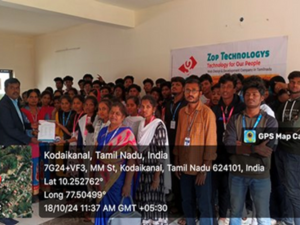
Zop Tech Web Development Company, Kodaikanal
Spectrum Soft Tech Solutions Pvt., Ltd., Kochi
Contact Us
Dr.S.G. SUSILA
Department of Information Technology
M.I.E.T. Engineering College,
Gundur, Trichy-07.
Mail ID: it.hod@miet.edu